Good news on the better fuel front: the Oregon Department of Agriculture approved Camelina meal for cattle and hog feed. This opens the door for Camelina, an oilseed that grows with little to no water or fertilizer in poor soil, to be produced more widely for biodiesel production in Oregon.
Camelina meal is what is left over after seeds are crushed for oil; the ODA ruling means that now farmers can sell all parts of the seeds, making it worthwhile for them to grow on their marginal lands.
Showing posts with label farmers. Show all posts
Showing posts with label farmers. Show all posts
Oct 2, 2008


Jul 16, 2008
What irrigated crop takes up three times more US landmass than corn?
What irrigated crop takes up three times more US landmass than corn?
Look no farther than your front lawn.
This is a story that was released a few years ago, but is still very relevant: people's lawns are slurping up a huge amount of water, fertilizer and herbicides, but giving very little back.
I'm going to try to keep this post from going too much into the benefits of urban gardens, and I know it leaves out those who live in apartments, but the impact of your (or your landlord's) lawn is something you should consider:
The world is facing many macro issues and quite honestly sometimes it makes you feel a bit helpless. But, as they say, change starts at home, and your personal water / land usage can make a positive impact on the world.
Other tips for saving water:
Get involved: Growing Gardens Portland
Bonus further reading: Sowing the Seeds of Urban Farming.
Look no farther than your front lawn.
This is a story that was released a few years ago, but is still very relevant: people's lawns are slurping up a huge amount of water, fertilizer and herbicides, but giving very little back.
I'm going to try to keep this post from going too much into the benefits of urban gardens, and I know it leaves out those who live in apartments, but the impact of your (or your landlord's) lawn is something you should consider:
- If you water your lawn, what time of day is it - think of evaporation.
- If you water your lawn, is there runoff onto your driveway or sidewalk?
- Could your lawn be doing more? Food, flowers and grass alternatives all make more of a positive impact than a lawn.
The world is facing many macro issues and quite honestly sometimes it makes you feel a bit helpless. But, as they say, change starts at home, and your personal water / land usage can make a positive impact on the world.
Other tips for saving water:
- Turn off the faucet while shaving or brushing your teeth
- Wash only full loads of dishes and laundry
- Fix dripping and leaking faucets and toilets
- Take shorter showers
- Wash cars less frequently
- Water lawns and gardens on alternate evenings, not every day
- Raise your lawn mower blade height; longer grass needs less water
Get involved: Growing Gardens Portland
Bonus further reading: Sowing the Seeds of Urban Farming.
Mar 24, 2008
We are using how much fuel?!
I was going to do a different sort of analysis about this... but the scale of these numbers just wowed me so I'll let them speak for themselves.
 Oregon's 2006 consumption of petroleum fuel:
4,314,400 gallons per day of gasoline (source)
2,266,600 gallons per day of diesel (source)
Oregon's 2006 consumption of biofuel:
38,356 gallons per day of ethanol (source)
10,959 gallons per day of biodiesel (source, which is a estimate)
Now with that in mind, how much of this is actually being produced in Oregon?
Oregon's 2006 production of petroleum fuel:
121 gallons per day of production capacity (source, I don't know if this is actually being produced)
Oregon's 2008 production of biofuel:
405,479 gallons per day of ethanol (source)
7,547 gallons per day of biodiesel (source)
So... what is the take away message here? Only a fraction of the fuel we use in Oregon is made from biofuel, but the impact has been huge:
 Oregon's 2006 consumption of petroleum fuel:
4,314,400 gallons per day of gasoline (source)
2,266,600 gallons per day of diesel (source)
Oregon's 2006 consumption of biofuel:
38,356 gallons per day of ethanol (source)
10,959 gallons per day of biodiesel (source, which is a estimate)
Now with that in mind, how much of this is actually being produced in Oregon?
Oregon's 2006 production of petroleum fuel:
121 gallons per day of production capacity (source, I don't know if this is actually being produced)
Oregon's 2008 production of biofuel:
405,479 gallons per day of ethanol (source)
7,547 gallons per day of biodiesel (source)
So... what is the take away message here? Only a fraction of the fuel we use in Oregon is made from biofuel, but the impact has been huge:
- Bringing fuel production back in state
- Giving farmers access to a new market
- Decreasing carbon dioxide emissions
- Proving that not only is there an alternative to petroleum fuel, there are thousands of people who want this alternative
Mar 11, 2008
Follow-up on food prices
The New York Times published an interesting (and albeit disturbing) article about food prices and how they are going up because of demand and worldwide crop shortages. One quote pretty much sums it all up:
[As an aside, I just have to mention that biofuels were not once mentioned in this article.]
What is really disturbing, something that I haven't been able to internalize yet, are the comments about how cheap food is not going to be reality for much longer. As a child of the 80's, I've never seen high commodity food prices, and I know that I've been taking this for granted.
Beans and rice have always been cheap, because they are beans and rice...
If these basic commodity prices go up, what happens to everyone who is depending on cheap food to feed their families? What happens to people who gave up farming because they can import cheaper grains?
This really is one more argument for local: take control of your food and take control of your fuel by sourcing from your region. When you need to augment your supply, import.
“Everyone wants to eat like an American on this globe."As the lives of people in developing nations stabilize, they move away from "traditional" crops and import more food. Supply and high demand at work, plus a little drought and failed crops equals higher prices. America's high production and the weak dollar are also at play.
[As an aside, I just have to mention that biofuels were not once mentioned in this article.]
What is really disturbing, something that I haven't been able to internalize yet, are the comments about how cheap food is not going to be reality for much longer. As a child of the 80's, I've never seen high commodity food prices, and I know that I've been taking this for granted.
Beans and rice have always been cheap, because they are beans and rice...
If these basic commodity prices go up, what happens to everyone who is depending on cheap food to feed their families? What happens to people who gave up farming because they can import cheaper grains?
This really is one more argument for local: take control of your food and take control of your fuel by sourcing from your region. When you need to augment your supply, import.
Mar 7, 2008
The search for better fuel starts with better plants
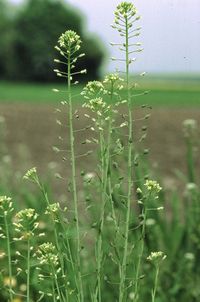 There is a new player on the local scene for biofuels - a plant called camelina. Camelina is part of the brassicaceae family along with canola, whose oil SeQuential uses in biodiesel production. Other more familiar brassicaceae are cabbage and turnips.
Camelina has been more or less overlooked in this region (with the exception of Montana) but its value as a rotational crop is starting to be realized. Rotational crops are used to break pest cycles and to revitalize soil that has only seen one crop grown on it season after season. Breaking pest cycles means that fewer pesticides have to be used, which is better for the health of farmers, laborers and the rest of us. This also decreases costs, as taken from the Eastern Oregonian:
... research shows [camelina] is well suited to conditions in the Pacific Northwest, requires low inputs of water and nutrients, and reduces disease, insect and weed pressure in wheat fields planted the following year.Camelina, just like canola, produces seeds that have a high oil content. These seeds get crushed by a crusher (Willamette Biomass Processors for example) that squeezes out the oil, which is turned into cleaner-burning biodiesel. The leftover crushed seed is a meal that goes to livestock as feed. I don't know what livestock think about camelina meal, but I know cows love canola meal - it was once described to me as 'cattle crack'.
"We are all painfully aware of the recent cost increases of inputs to grow conventional crops," he said, noting the cost of glyphosate, the main ingredient in products such as Round-Up, for example, increased significantly recently.
"If you are concerned about these costs, you should look at a crop like camelina," Johnson said. 'It can provide a net return equal to spring wheat without the high initial outlay of pesticides and a far lower need for nitrogen and we can harvest in July."
So why am I excited about camelina? Both camelina and canola are rotational oilseed crops that don't require much water or fertilizer and canola actually has a higher output of oil per acre. More oil = more biodiesel, but because camelina is better on the land and can be grown on marginal soil, it pulls ahead as a better choice in my book.
Subscribe to:
Posts (Atom)
