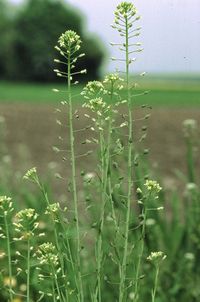
 There is a new player on the local scene for biofuels - a plant called camelina. Camelina is part of the brassicaceae family along with canola, whose oil SeQuential uses in biodiesel production. Other more familiar brassicaceae are cabbage and turnips.
Camelina has been more or less overlooked in this region (with the exception of Montana) but its value as a rotational crop is starting to be realized. Rotational crops are used to break pest cycles and to revitalize soil that has only seen one crop grown on it season after season. Breaking pest cycles means that fewer pesticides have to be used, which is better for the health of farmers, laborers and the rest of us. This also decreases costs, as taken from the Eastern Oregonian:
... research shows [camelina] is well suited to conditions in the Pacific Northwest, requires low inputs of water and nutrients, and reduces disease, insect and weed pressure in wheat fields planted the following year.Camelina, just like canola, produces seeds that have a high oil content. These seeds get crushed by a crusher (Willamette Biomass Processors for example) that squeezes out the oil, which is turned into cleaner-burning biodiesel. The leftover crushed seed is a meal that goes to livestock as feed. I don't know what livestock think about camelina meal, but I know cows love canola meal - it was once described to me as 'cattle crack'.
"We are all painfully aware of the recent cost increases of inputs to grow conventional crops," he said, noting the cost of glyphosate, the main ingredient in products such as Round-Up, for example, increased significantly recently.
"If you are concerned about these costs, you should look at a crop like camelina," Johnson said. 'It can provide a net return equal to spring wheat without the high initial outlay of pesticides and a far lower need for nitrogen and we can harvest in July."
So why am I excited about camelina? Both camelina and canola are rotational oilseed crops that don't require much water or fertilizer and canola actually has a higher output of oil per acre. More oil = more biodiesel, but because camelina is better on the land and can be grown on marginal soil, it pulls ahead as a better choice in my book.


